Older architecture throughout Allegheny County frequently exhibits cut-stone, fieldstone, or unreinforced terra-cotta block foundations. In neighborhoods such as Lawrenceville, South Side Flats, and Bloomfield,…
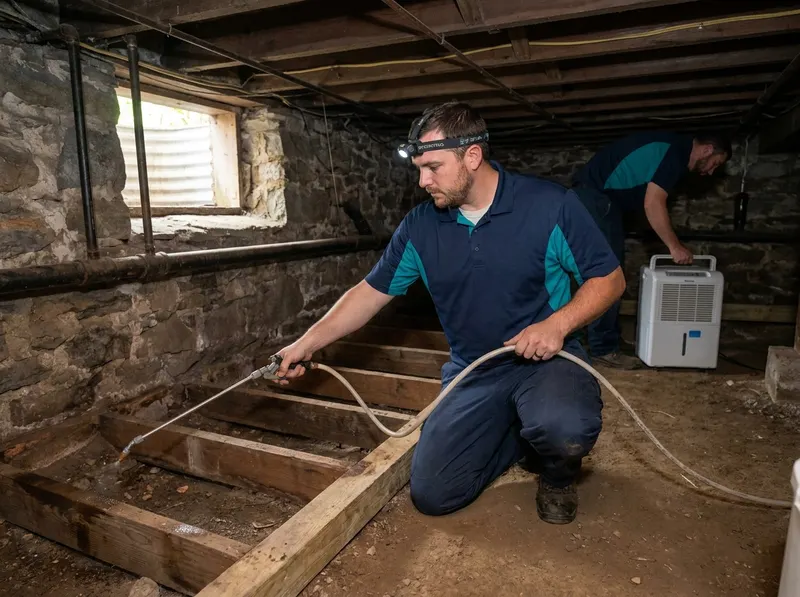
Older architecture throughout Allegheny County frequently exhibits cut-stone, fieldstone, or unreinforced terra-cotta block foundations. In neighborhoods such as Lawrenceville, South Side Flats, and Bloomfield, structures situated on alluvial soil terraces or steep clay slopes absorb high volumes of hydrostatic runoff. Relative humidity levels exceeding 70% in unconditioned basements and dirt crawlspaces cause floor joists and subflooring to retain moisture above 18% to 20%. This internal microclimate creates a primary attractant for wood-destroying organisms like carpenter ants and subterranean termites, alongside nuisance aggregations of camel crickets and centipedes that feed on sub-grade mold biofilms.
Surface broadcast sprays fail to resolve sub-grade infestations because liquid biocides break down rapidly in ambient dampness and do nothing to halt continuous infiltration through deteriorating mortar joints. Effective moisture pest abatement combines physical barriers with targeted environmental reduction. Technicians assess masonry gaps beneath balloon framing, install 12-mil or 20-mil reinforced polyethylene soil covers sealed to foundation perimeters, and direct water vapor away from structural framing members. Where foundation weeping occurs near landmarks like Grandview Avenue on Mount Washington or near the steep runoff basins of Schenley Park, French drain channels and crawlspace dehumidification systems hold ambient basement humidity below 50%, halting the fungal and insect lifecycle at its environmental source.
Homeowners selecting between localized chemical barrier treatment and complete moisture pest abatement must evaluate structural timber longevity against upfront scope. Local spot treatments address active insect colonies in floor plates within 48 hours for immediate relief, but unaddressed foundation dampness leads to secondary re-infestation within 6 to 12 months. Structural moisture abatement requires clearing stored items, remediating wet rubble foundations, and mechanically regulating relative humidity. This comprehensive scope permanently stabilizes the foundation envelope against recurring perimeter incursions across historic properties in Shadyside, Squirrel Hill, and Brookline.
Every job gets a firm, written price after a free on-site visit.
Tell us about your crawlspace and basement moisture pest abatement job in Pittsburgh and we'll send a clear, written quote, usually the same day.
 Fentaro Pest Solutions