Older architecture throughout Pittsburgh, from 19th-century timber frames in Lawrenceville and South Side Flats to solid masonry row houses in Bloomfield and East Liberty, presents structural voids where common…
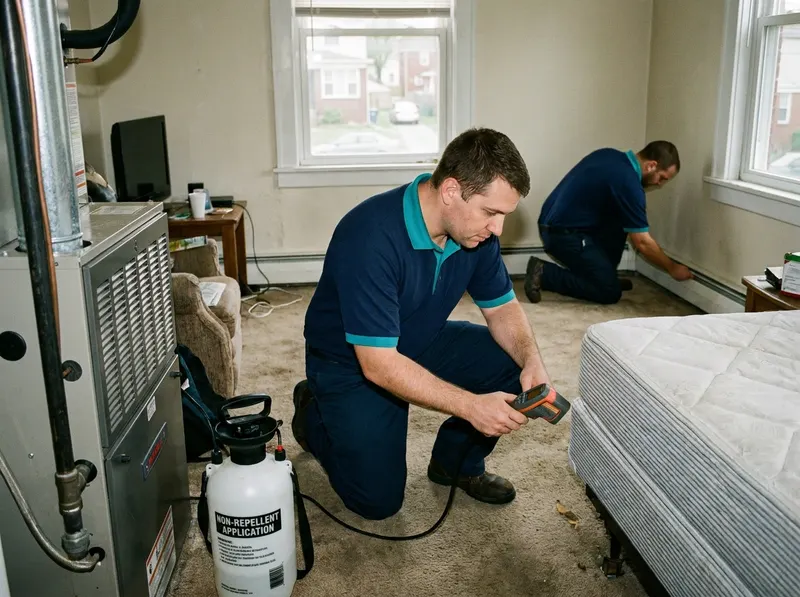
Older architecture throughout Pittsburgh, from 19th-century timber frames in Lawrenceville and South Side Flats to solid masonry row houses in Bloomfield and East Liberty, presents structural voids where common over-the-counter contact sprays fail. When standard pyrethroid sprays strike a surface, bed bugs detect the chemical repellent, flee deeper into plaster lath or baseboards, and spread across party walls into adjoining bedrooms. Non-repellent active ingredients like chlorfenapyr or dinotefuran operate invisibly to insect receptors; pests traverse the barrier without triggering avoidance behavior, mechanically transferring the agent directly into harborages behind radiator covers and under floor trim.
Thermal remediation resolves the limitation of chemical resistance by elevating ambient indoor air temperatures to between 125 and 135 degrees Fahrenheit. Specialized convective heaters circulate controlled thermal currents, raising the core temperature of mattress tufts, deep wall framing, and subfloors past the thermal death point of 122 degrees Fahrenheit within 90 minutes. A whole-home thermal treatment eliminates all life stages on contact, including desiccating the protective chitinous shell of unhatched eggs that standard residual insecticides cannot penetrate alone. The operational trade-off of whole-home convective heat involves intensive pre-treatment preparation, such as relocating meltable electronics, aerosol containers, vinyl blinds, and temperature-sensitive prescription medications, against the immediate speed of an insect-free environment in a single working day.
For multi-story structures in Squirrel Hill, Mount Washington, and Brookline, remediation combines non-repellent micro-encapsulated residuals with localized thermal perimeter barriers. This integrated sequence handles structural nuances: cold exterior stone foundations often retain perimeter thermal sinks that slow heat absorption. Precision diagnostics require placing calibrated digital thermistor probes inside deep furniture joints and subfloor boundaries to ensure minimum kill temperatures hold for at least 60 continuous minutes. Non-repellent applications then secure wall outlets, baseboard margins, and pipe penetrations to eliminate any insects attempting to migrate into structural wall voids.
Every job gets a firm, written price after a free on-site visit.
Tell us about your thermal and non-repellent bed bug eradication job in Pittsburgh and we'll send a clear, written quote, usually the same day.
 Fentaro Pest Solutions