Flea and tick yard and structural abatement stops parasitic vectors from establishing self-sustaining populations between exterior soil reserves and residential sub-flooring. Older residential properties in Pittsburgh…
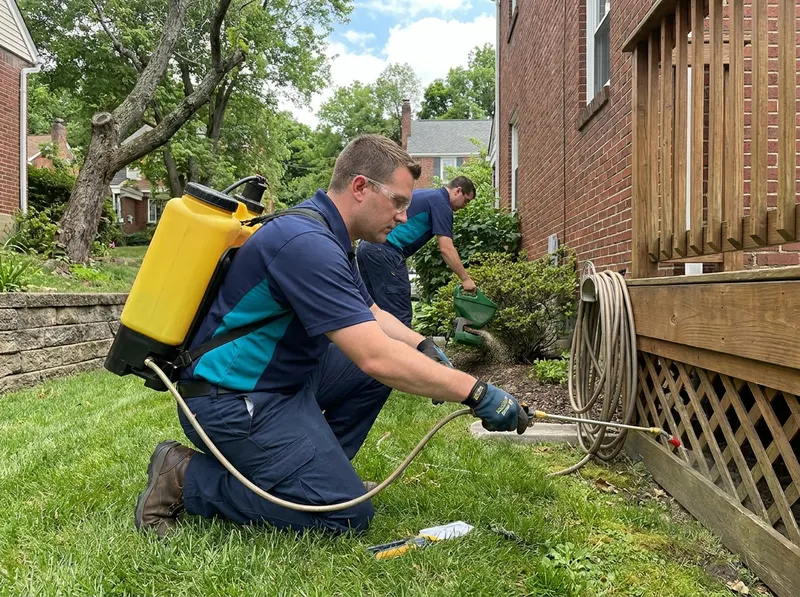
Flea and tick yard and structural abatement stops parasitic vectors from establishing self-sustaining populations between exterior soil reserves and residential sub-flooring. Older residential properties in Pittsburgh neighborhoods such as Squirrel Hill, Shadyside, and Lawrenceville feature mature tree canopies, shaded clay loam soils, and stone foundation masonry that preserve moisture levels required for larval development. Ixodes scapularis (blacklegged tick) populations migrate into yard peripheries via whitetail deer corridors intersecting Frick Park and Schenley Park. Concurrently, feral animal movements introduce Ctenocephalides felis (cat flea) pupae into leaf litter adjacent to low foundation sills. Without physical habitat disruption and residual chemical regulation, emerging parasites attach to domestic animals and penetrate floorboards, transitioning into indoor rugs, baseboards, and HVAC returns.
Effective containment requires establishing two distinct physical zones rather than relying on standard topical chemical applications. Zone one treats the exterior ground surface: specialized micro-encapsulated formulations and adulticides are applied to turf margins, perimeter perimeter plantings, and shaded underbrush up to a height of 3 feet, coupled with a granular synthetic barrier across boundary fence lines. Zone two addresses structural vulnerabilities: in brick row houses and Victorian frames common to Bloomfield, East Liberty, and South Side Flats, basements constructed from porous fieldstone or mortar-jointed sandstone allow outdoor humidity to create flea pupation sites in subfloor crevices. Targeted low-pressure micro-injections along sill plates, rim joists, and baseboard junctures deposit an insect growth regulator (pyriproxyfen) that halts the reproductive molt cycle of flea larvae for 90 to 180 days.
Property layout determines the specific balance between perimeter granular rings and liquid barrier sprays. Properties situated on steep topography, such as hillside lots in Mount Washington and Brookline, require micro-encapsulated granular applications along sloped retainment boundaries to prevent rainfall runoff into municipal catch basins before the active ingredients bind to soil particles. Conversely, flat urban parcel yards with dense ground cover require high-volume power-dispersion to reach subterranean thatch layers where flea larvae feed on organic detritus. The trade-off between exterior turf treatment and comprehensive interior floorboard abatement hinges on domestic pet access: if hosts have carried adults indoors, treating the yard alone permits indoor pupal emergence for up to 30 continuous days.
Every job gets a firm, written price after a free on-site visit.
Tell us about your flea and tick yard and structural abatement job in Pittsburgh and we'll send a clear, written quote, usually the same day.
 Fentaro Pest Solutions